
Communication between schools and parents plays an important role in every student's educational experience.
Parents need accurate information about attendance, homework, school events, payments, transportation and important announcements. At the same time, schools need a reliable way to deliver this information without depending on scattered phone calls, paper notices and separate WhatsApp conversations.
When communication is not organized, important messages can be missed, parents may receive different information, and administrative staff spend more time answering repetitive questions.
A structured digital communication process can make the relationship between the school and families clearer, faster and easier to manage.
Why school-parent communication matters
Parents are important partners in a student's education.
When families receive clear and timely information, they are better able to:
- Follow their child's attendance
- Support homework and academic responsibilities
- Prepare for school events
- Review tuition and payment information
- Respond to school requests
- Notify the school about important changes
- Support their child's progress
Strong communication also helps schools build trust with families.
Parents feel more confident when they know where to find reliable information and how the school will contact them when necessary.
Common communication problems in schools
Many schools still communicate through several disconnected channels.
For example, an announcement may be sent through WhatsApp, attendance information may be recorded on paper, payment reminders may be sent by phone, and homework may be shared through another application.
This creates several problems:
- Parents may miss important messages
- Different families may receive different information
- Administrative staff must repeat the same answer
- Messages can become difficult to track
- Old information may remain in circulation
- Personal phone numbers may be used unnecessarily
- Schools may not know whether a notice was delivered
The problem is not a lack of communication.
The problem is that communication is often spread across too many places.
1. Use one official communication channel
Every school should define one official place where parents can receive important information.
This does not mean that the school can never use phone calls or email.
It means that official announcements, attendance information, payment notices and school updates should also be available through one organized platform.
A centralized communication channel gives parents a clear source of information.
It also helps the school maintain a consistent record of what was shared.
2. Organize school announcements
School announcements should be easy to create, publish and review.
Examples include:
- School closures
- Exam schedules
- Holiday notices
- Registration dates
- Parent meetings
- Uniform reminders
- Health and safety notices
- Changes to school hours
Every announcement should include a clear title, date and message.
The school should avoid sending several incomplete messages about the same subject. One complete announcement is easier for parents to understand and reduces unnecessary questions.
3. Share events and agendas clearly
Parents need advance notice about important school activities.
A digital school calendar can help families prepare for:
- Exams
- School trips
- Parent meetings
- Sports activities
- School celebrations
- Academic deadlines
- Holidays
- Special programs
When events are organized in one place, parents do not need to search through old messages to remember a date.
The school can also update the event if the time or location changes.
4. Improve attendance communication
Attendance is one of the most important areas of school-parent communication.
Parents should be able to receive clear information when their child is absent or when the school needs to follow up on repeated absence.
A digital attendance process can help the school:
- Record attendance consistently
- Review a student's attendance history
- Identify repeated absence
- Notify the appropriate parent
- Prepare attendance reports
- Reduce manual follow-up
Attendance notifications should remain clear and factual.
The message should identify the student, date and attendance status without including unnecessary information.
5. Make homework and academic information easier to follow
Parents often need visibility into homework, assignments and important academic tasks.
This does not mean that parents should complete the student's work.
The purpose is to help families understand what the student is responsible for and when important work is due.
Schools can organize:
- Homework
- Assignments
- Project deadlines
- Exam dates
- Teacher notes
- Academic reminders
When academic information is shared consistently, students and parents are less likely to miss important deadlines.
6. Communicate tuition and payment information clearly
Payment communication can become sensitive when information is unclear or delivered inconsistently.
Parents should be able to understand:
- The total invoice amount
- The amount already paid
- The remaining balance
- The payment due date
- Whether a payment is overdue
- The payment history
A centralized payment record reduces confusion and makes follow-up easier for both the school and the family.
Payment reminders should be professional and respectful.
They should explain what is due and how the parent can contact the school if clarification is required.
7. Keep transportation information organized
Parents need reliable information about school transportation.
The school should maintain accurate records for:
- Students using school buses
- Assigned buses
- Drivers
- Routes
- Stops
- Morning trips
- Afternoon trips
- Family contact information
When a route or schedule changes, parents should receive a clear notification.
Transportation communication is especially important because it relates directly to student safety and daily planning.
8. Communicate in the family's preferred language
Schools may serve families who prefer different languages.
Where possible, important announcements should be available in the languages used by the school community.
For Eduync schools, this may include English, Arabic or French.
Providing multilingual communication helps reduce misunderstanding and makes important information more accessible.
Translations should communicate the same meaning in each language rather than using an unclear automatic translation.
9. Protect parent and student information
Convenient communication must also remain secure.
Schools should avoid sharing sensitive student or family information in public groups.
Access to student records, payment information, attendance and documents should be limited to authorized users.
A parent should only see information related to their own children.
School staff should also use official school accounts rather than personal contact methods whenever possible.
10. Set clear communication responsibilities
The school should define who is responsible for each type of communication.
For example:
- Administration publishes official announcements
- Teachers share academic information
- Accounting manages payment notices
- Transportation staff manage route updates
- Authorized staff respond to parent inquiries
Clear responsibilities reduce duplicate messages and help parents receive more consistent answers.
The school should also decide how quickly different inquiries should receive a response.
An urgent transportation issue may require a faster response than a general request for information.
11. Avoid sending too many notifications
More notifications do not always create better communication.
When parents receive too many messages, they may begin to ignore them.
Schools should separate urgent communication from normal updates.
Urgent notifications may include:
- Emergency school closures
- Transportation changes
- Immediate health or safety information
- Unexpected schedule changes
Normal updates may include:
- News
- Upcoming events
- General reminders
- School activities
The objective is to send the right information at the right time.
12. Give parents one clear view of their children
A parent with more than one child at the same school should not need separate, disconnected accounts.
The parent account should provide access to each linked child while keeping the information organized.
The parent may need to review:
- Attendance
- Homework
- Payments
- Announcements
- Events
- Notifications
- Transportation information
Connecting children to one family account makes the experience simpler and reduces duplicate records.
A practical school communication checklist
Before the academic year begins, schools can review the following questions:
- Do parents have one official communication channel?
- Are parent phone numbers and email addresses updated?
- Can announcements be published in English and Arabic?
- Can parents review attendance information?
- Are homework and academic reminders organized?
- Can parents understand their payment status?
- Are transportation updates connected to the correct students?
- Is sensitive information protected?
- Does each department know what it is responsible for communicating?
- Can the school review what information has already been sent?
Schools do not need to change every process at the same time.
They can begin with the areas that create the most repetitive work and confusion.
How Eduync supports school-parent communication
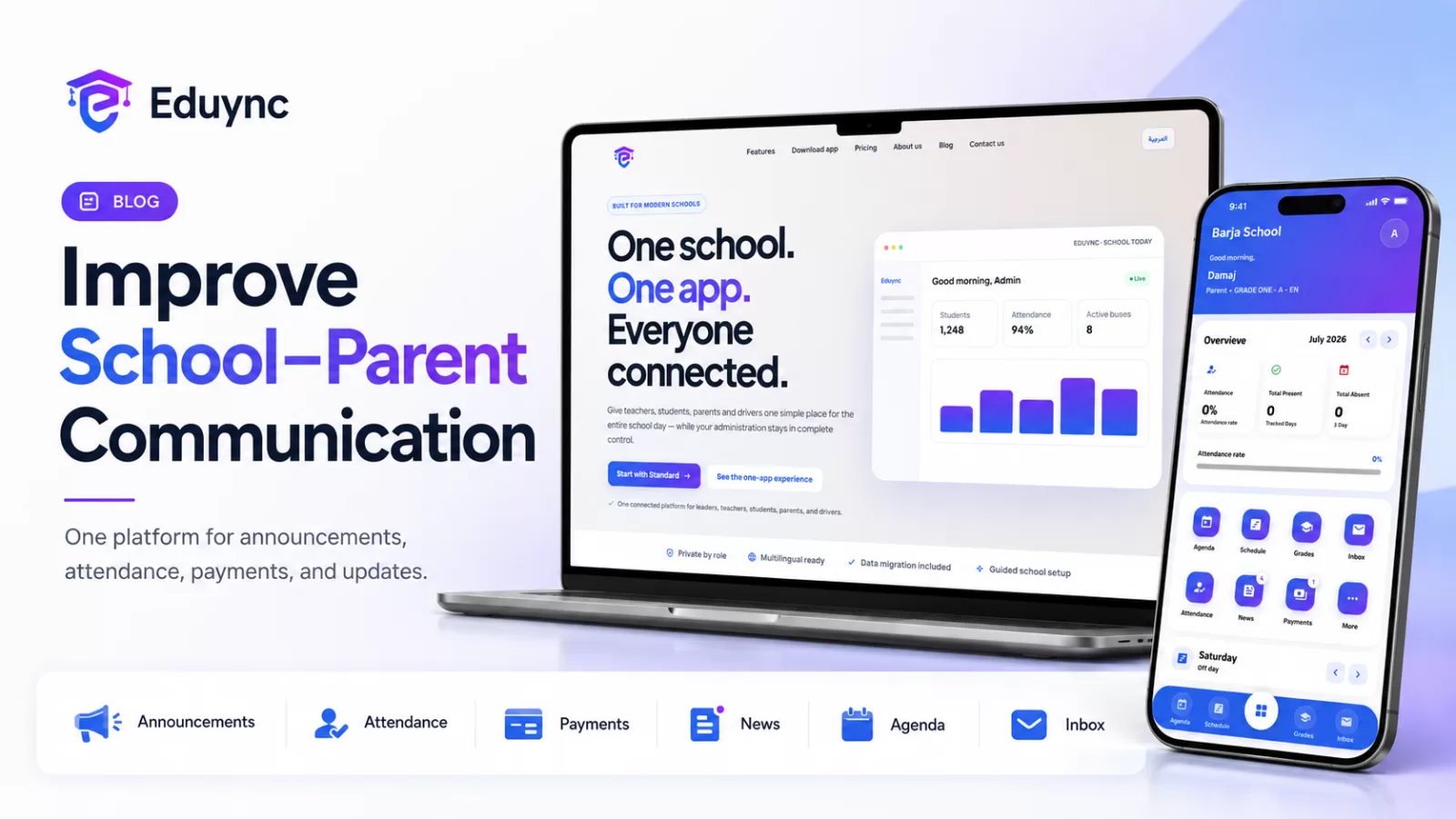
Eduync brings school communication and administration together within one platform.
Schools can organize students and families while managing announcements, events, agendas, attendance, payments, documents, notifications and transportation information.
Parents can receive information connected to their own children, while the school maintains a clearer and more organized communication process.
The objective is not simply to send more messages.
The objective is to give parents the right information while reducing repetitive administrative work for the school.
Clear communication creates stronger relationships between schools and families.
When parents know where to find reliable information, they can support their children more effectively and communicate with the school with greater confidence.
Ready to improve communication between your school and parents?
Request a 14-day Eduync demo and explore how your school can manage communication and daily operations from one platform.