
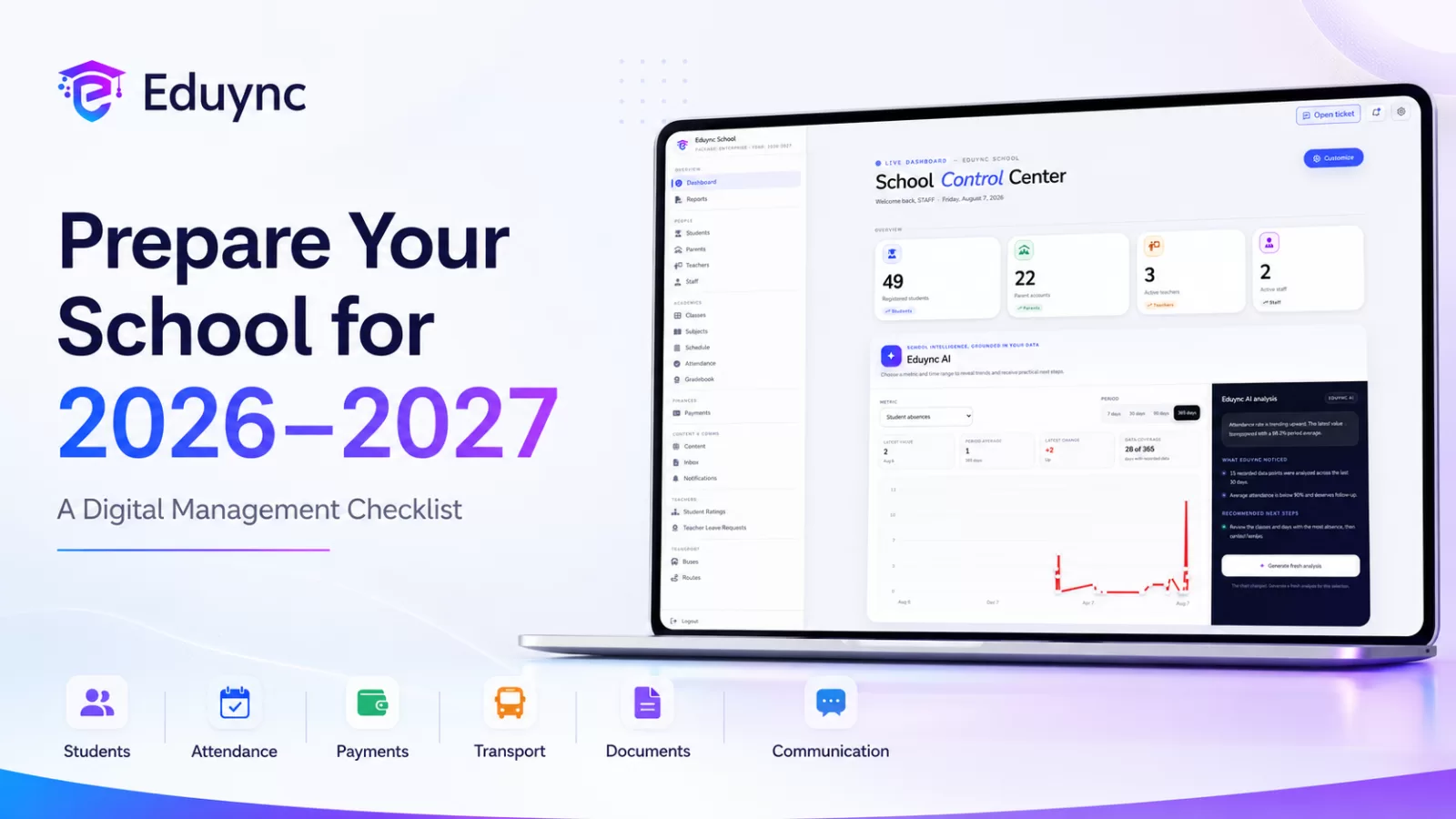
The start of a new academic year is one of the busiest periods for any school.
Before students return to their classrooms, school administrators need to organize registrations, student records, parents, teachers, classes, sections, transportation, fees, documents, attendance processes and school communication.
When this information is divided between spreadsheets, paper files, WhatsApp conversations and different computers, even simple administrative tasks can become difficult.
For the 2026–2027 academic year, schools can use the preparation period as an opportunity to organize their operations digitally.
Here is a practical checklist.
1. Review student and family records
Start by making sure every student's information is complete and up to date.
Schools should verify:
- Student name and contact information
- Parent or guardian information
- Grade and section
- Emergency contacts
- Required documents
- Transportation information
- Relevant academic records
Keeping the student and parent records connected makes administration easier throughout the year.
Instead of searching through several files whenever information is needed, authorized staff can access the correct student record from one place.
2. Organize new student enrollment
Enrollment is often one of the first major administrative tasks of the school year.
A structured digital enrollment process can help schools collect student information, parent information and required documents while reducing duplicate records.
The objective should be simple: create the family once and connect all related students to it.
This is especially useful for families that have two or more children attending the same school.
3. Prepare grades, classes and sections
Before the first school day, the school's academic structure should already be organized.
For example:
Grade 1
Section A
English program
Assigned teacher
Registered students
When grades, sections, teachers and students are connected correctly, attendance, reporting and communication become easier later.
Changes should also be easy to make when a student moves between sections or a teacher assignment changes.
4. Assign teachers and staff
Schools should review their teacher and staff records before the new year begins.
Check contact information, assigned classes, roles and required documents.
School administrators should also make sure that every user receives the correct access level.
A teacher should see the information required for teaching and managing assigned students, while administrative staff may require wider access.
Good digital school management is not only about storing information. It is also about giving the right information to the right person.
5. Prepare attendance from the first day
Attendance should not require administrators to collect information from several notebooks or spreadsheets.
A digital attendance process allows the school to maintain one consistent record for students.
This can help administrators identify absences, review attendance history and prepare reports more quickly.
It can also improve communication with parents when attendance information needs to be shared.
6. Prepare tuition fees and payment records
Financial administration becomes much easier when payment information is organized before invoices begin accumulating.
Schools should prepare:
- Student invoices
- Due dates
- Paid amounts
- Outstanding balances
- Overdue payments
- Payment history
A centralized system also makes it easier to identify accounts that require follow-up without manually comparing multiple spreadsheets.
Parents benefit as well because payment information can be clearer and easier to access.
7. Organize school transportation
Transportation planning should be completed before students begin travelling to school.
Schools need accurate information about students using school buses, family locations, drivers, routes, stops and morning or afternoon trips.
Digital transportation management helps administrators keep these records connected to the students who actually use the service.
It also makes route changes easier to manage during the academic year.
8. Centralize important documents
Student, parent, teacher and staff documents should not be scattered across different computers or physical folders.
A structured digital document system helps schools organize files according to the correct person.
This can include registration documents, identification files and other school records.
Authorized administrators can then find a document without searching through several folders.
9. Prepare parent communication
Parents expect clear and timely information from their children's school.
Before the academic year begins, decide how your school will communicate:
- School announcements
- Events
- Agendas
- Attendance information
- Homework
- Fee information
- Important notifications
Using one organized communication channel can reduce repetitive phone calls and scattered messages.
It also gives families a clearer connection with the school.
10. Make information useful for school management
Digital transformation should do more than replace paper with a computer.
The real benefit comes when school information becomes easier to understand and use.
Administrators should be able to answer questions such as:
How many students are registered?
Which payments are overdue?
Which students were absent?
Which students use school transportation?
Which documents are missing?
Which classes or sections are reaching capacity?
When information is centralized, these questions become much easier to answer.
Digital transformation in Lebanese schools
Technology is becoming increasingly important across Lebanon's education sector.
The country's education digital transformation direction places students, teachers and schools at the center of a more modern educational environment.
For individual schools, digital transformation does not have to begin with a complicated project.
It can begin by solving everyday administrative problems one at a time.
Enrollment can become easier.
Attendance can become clearer.
Payments can become more organized.
Parent communication can become faster.
School records can become easier to manage.
How Eduync can help
Eduync is designed to bring everyday school operations together in one platform.
Schools can manage students, parents, teachers, staff, classes, attendance, payments, documents, transportation, communication and other administrative processes without depending on disconnected tools.
The goal is simple: reduce repetitive administrative work and give schools a clearer view of their daily operations.
As schools prepare for the 2026–2027 academic year, it is a good time to review current processes and decide which tasks can be made simpler.
A well-organized school year starts before the first student enters the classroom.
Ready to see how Eduync can support your school?
Request a 14-day Eduync demo and explore the platform with your own school workflow.